CarbonTracer

for calculating greenhouse gas emissions from transport and mobility

Forecasting - Backcasting - Nowcasting - Commuting

Last Updates (2025/07/17)

The website, web apps and API are now also available in English
Widget to integrate into your website
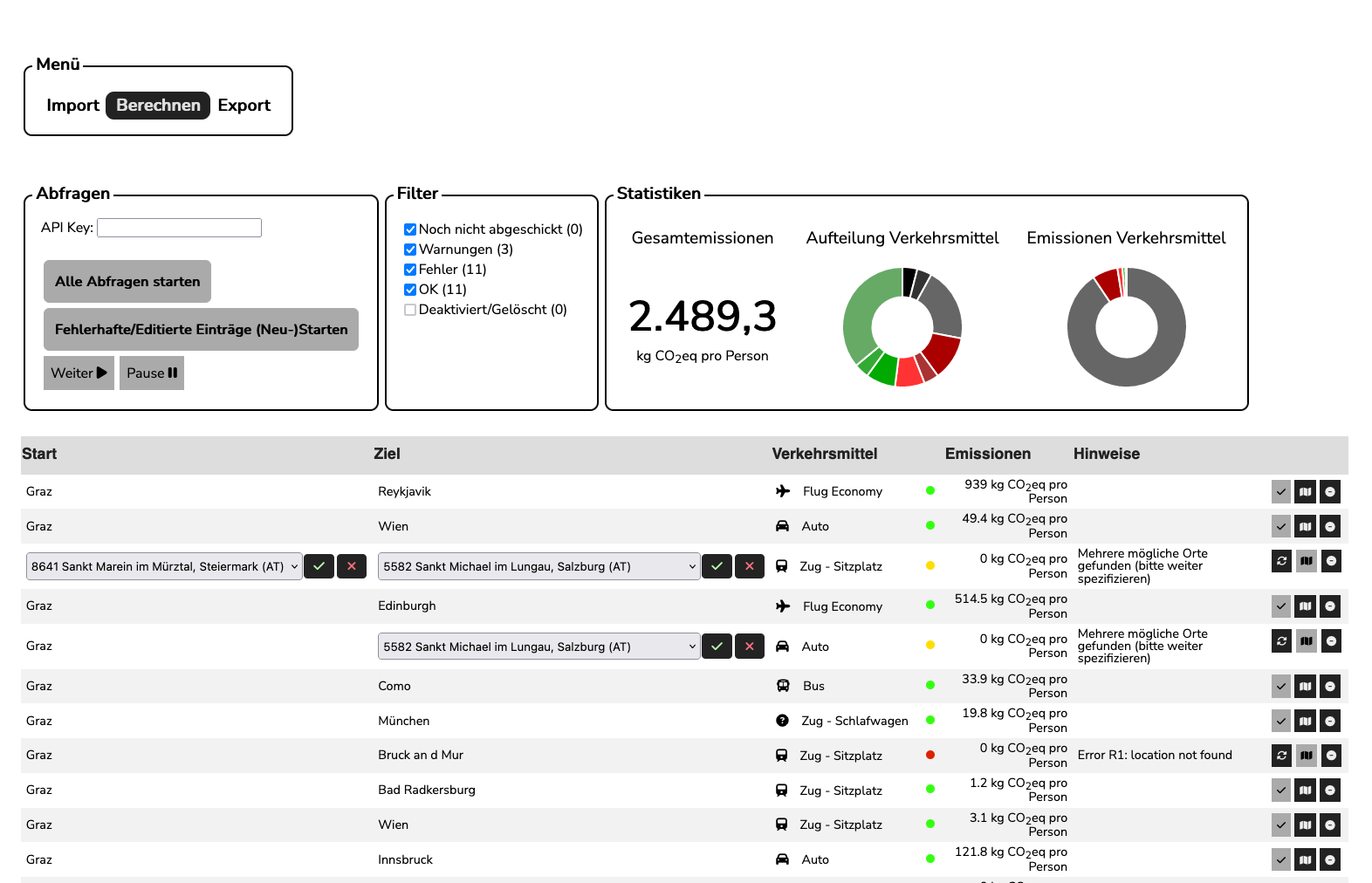
List processing: Processing of many business trips directly on the website

What is CarbonTracer and what does it do?

CarbonTracer is a service for reliable calculation and realistic mapping of greenhouse gas emissions in the field of mobility, differentiating between different forms of transport. The entire life cycle of the relevant mode of transport is factored in. The key points are listed below; a brief overview with further details is included in this information do cument. information document [german language]‚ (CMInfo-CarbonTracerService_Aug2023.pdf).  

Who can use CarbonTracer?

CarbonTracer is a free service and can be used by organisations, institutions or individuals for projects of any kind.

The service can be integrated into your own application using a REST API, or, for example, into Excel using a plain text API. For individual queries, a simple web application is available.

How does CarbonTracer work?

Greenhouse gas emissions are estimated using route calculations based purely on open services and freely available data.

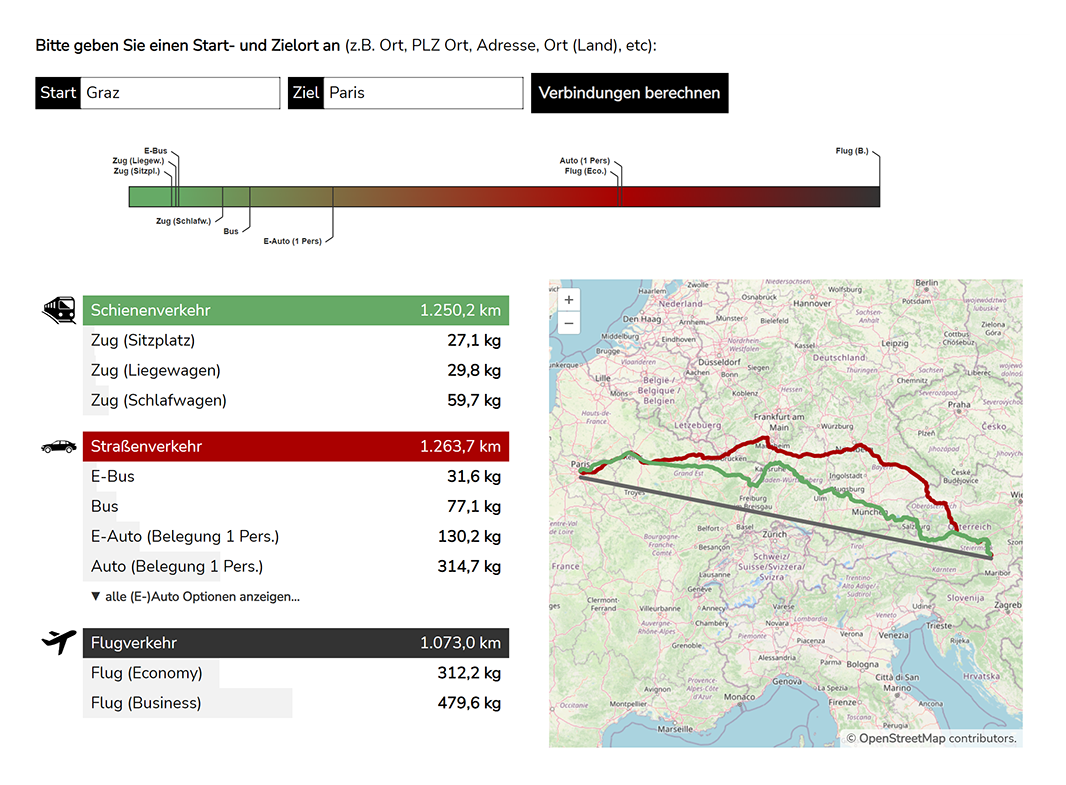
Testing CarbonTracer

Step 1: Enter start and destination
Step 2: Please select mode of transport:
 
Emissions: XX kg CO2eq per person
API Request
https://api.carbontracer.uni-graz.at/routing/[API-KEY]/car/Graz/München
API Response

What is CarbonTracer and what does it do?

CarbonTracer is a service for reliable calculation and realistic mapping of greenhouse gas emissions in the field of mobility, differentiating between different forms of transport. The entire life cycle of the relevant mode of transport is factored in.

The service is particularly helpful in the following areas:

  • Forecasting: Planning travel/business trips (comparison of greenhouse gas emissions for different modes of transport)
  • Backcasting: Greenhouse gas emissions for past travel/business trips (monitoring greenhouse gas emissions)
  • Nowcasting: Live calculation of greenhouse gas emissions (e.g. overlay app with emissions tracking during the journey)
  • Commuting: Analysis/comparison of commuter journeys for more climate-friendly commuting

CarbonTracer’s strengths

  • Emissions calculations are kept up to date by the Wegener Center using the latest scientific publications
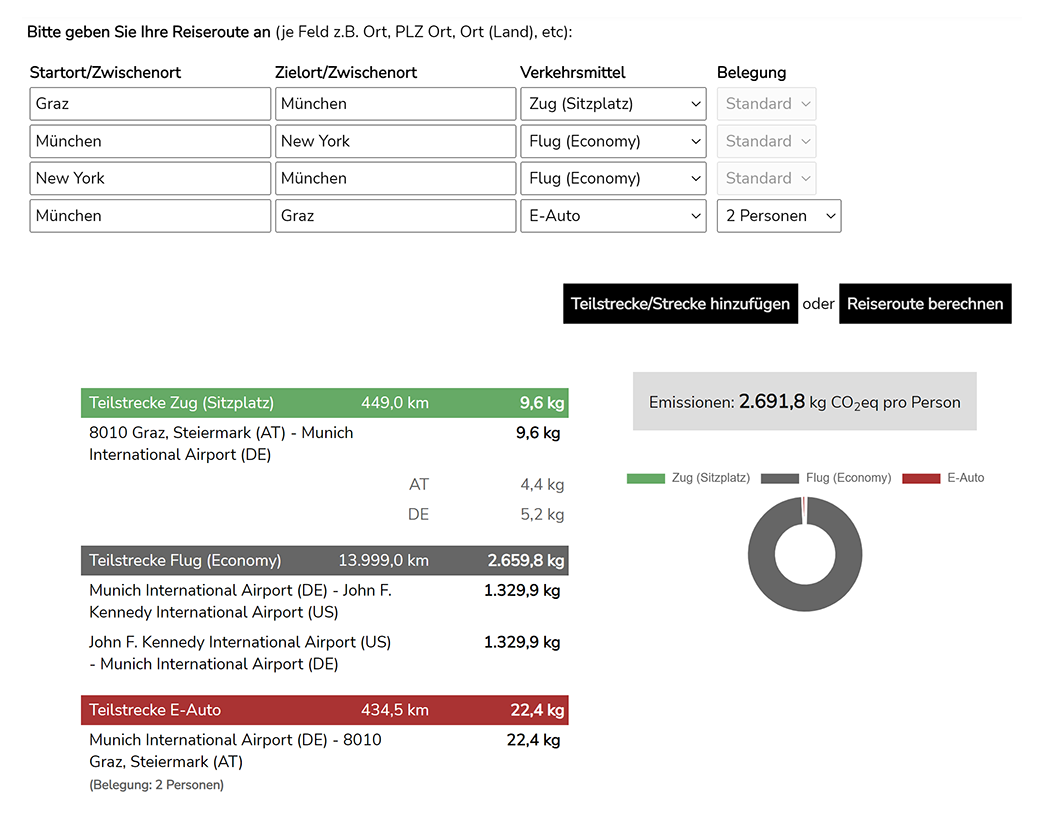
  • Includes partial journeys (e.g. intermediate stops/stopovers)
  • Includes different c used during the journey
    • Rail travel: train (seat, sleeper, couchette)
    • Road travel: electric bus, bus, electric car, car
    • Air travel: flight (economy, business, first class)

For rail travel

  • Takes account of different levels of electrification and power supply in European countries
  • Splits journeys into segments by country for cross-border journeys
  • Maps actual routes for rail, car and bus journeys (using rail and street maps)

For air travel

  • Includes CO2-equivalent calculation of climate-affecting non-CO2 impacts from increased radiative forcing in the atmosphere (effects of flight altitude)
  • Takes account of the uplift factor based on the latest research
  • Distinguishes between short- and long-haul flights

Who can use CarbonTracer?

CarbonTracer is a free service and can be used by Organisationen, organisations, institutions or individuals for projects of any kind. To use the service, you need a valid API-Key, , which is provided when you register (free of charge) on this platform. Each API key allows up to 40 requests per minute and 2,000 requests per day

How can I use CarbonTracer?

To connect via Machine2Machine (M2M) you have the following options:
  • Integration into your own application using a REST-API or a plain text API
  • Queries in Excel using the plain text API
For individual queries there are also two web apps available which refer directly to our service: Registered users can also integrate the CarbonTracer directly into their website For processing larger amounts of data, you can now also process a list of trips via a CSV file directly on the website